
Articles
Labuan Audit vs Malaysia Sdn Bhd Audit – What’s the Difference?
Summary Content:
- Governing Laws
- Audit Scope Differences
- Tax Implications
- Reporting Standards
When setting up a company in Malaysia, one critical compliance question arises:
Do you fall under Labuan audit requirements or Malaysia Sdn Bhd audit obligations?
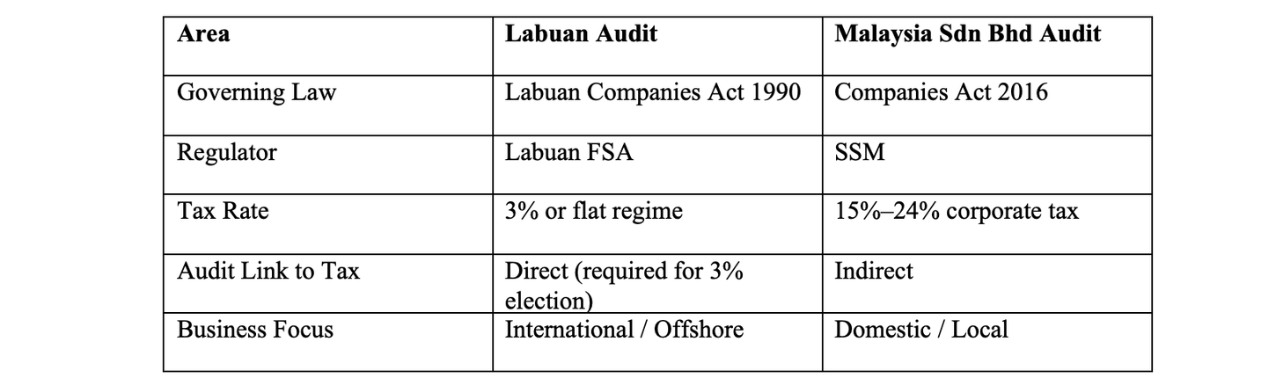
Although both involve statutory audits, the governing laws, tax treatment, and reporting standards differ significantly. Below is a clear breakdown.
Do you fall under Labuan audit requirements or Malaysia Sdn Bhd audit obligations?
Although both involve statutory audits, the governing laws, tax treatment, and reporting standards differ significantly. Below is a clear breakdown.
Governing Laws
Labuan Companies
Companies incorporated in Labuan International Business and Financial Centre are governed by:
Malaysia Sdn Bhd Companies
Companies incorporated in mainland Malaysia are governed by:
Companies incorporated in Labuan International Business and Financial Centre are governed by:
- Labuan Companies Act 1990
- Regulated by Labuan Financial Services Authority (Labuan FSA)
Malaysia Sdn Bhd Companies
Companies incorporated in mainland Malaysia are governed by:
- Companies Act 2016
- Regulated by Companies Commission of Malaysia (SSM)
Audit Scope Differences
1️⃣ Nature of Business
Labuan Companies
Labuan Companies
- Typically international trading, holding, leasing, investment activities
- Often cross-border structures
- Focus on offshore or midshore transactions
- Domestic trading, services, manufacturing
- Primarily local operations
- Subject to broader operational regulations
2️⃣ Audit Focus
Labuan Audit
- Compliance with Labuan regulatory framework
- Offshore income classification
- Substance requirements
- Verification of Labuan tax election (3% or flat tax regime)
- Full statutory audit of financial statements
- Compliance with Malaysian Financial Reporting Standards
- Local tax compliance under Income Tax Act 1967
Tax Implication
Labuan Company Tax
Under the Labuan Business Activity Tax Act 1990:
Malaysia Sdn Bhd Tax
Governed by the Income Tax Act 1967:
Under the Labuan Business Activity Tax Act 1990:
- 3% tax on net audited profits (for Labuan trading activities), or
- RM20,000 flat tax (for certain non-trading activities, subject to current rules)
Malaysia Sdn Bhd Tax
Governed by the Income Tax Act 1967:
- Standard corporate tax rate: 24%
- SME rate: 15%–17% on first chargeable income threshold (subject to prevailing rules)
Reporting Standards
Labuan Companies
Financial statements may be prepared under:
Financial statements may be prepared under:
- IFRS
- Malaysian Financial Reporting Standards (MFRS)
- Other approved accounting standards (subject to Labuan FSA requirements)
Malaysia Sdn Bhd
Financial statements must comply with:
- MFRS or MPERS
- Filed with SSM annually
Conclusion
Choosing between a Labuan company and a Malaysia Sdn Bhd is not just about tax rates — it’s about compliance structure, regulatory expectations, and long-term business strategy.
A proper understanding of Labuan audit requirements ensures:
A proper understanding of Labuan audit requirements ensures:
- Tax efficiency
- Regulatory compliance
- Smooth annual filings
- Reduced penalty risks
Our Qualification and Recognition



Kuala Lumpur Office
38D, 3rd Floor, Jalan Radin Anum, Bandar Baru Sri Petaling, 57000 Kuala Lumpur, Malaysia
Petaling Jaya Office
D-1-32, Block D, 8 Avenue, Jalan Sungai Jernih 8/1, Section 8, 46050 Petaling Jaya, Selangor Darul Ehsan, Malaysia
Labuan Office
Office Suite 1605, Level 16 (A), Main Office Tower, Financial Park Complex Labuan, Jalan Merdeka, 87000 Labuan F.T, Malaysia